
By Jasmine Benjamin, PhD, Program Officer for Community Investments, Field Foundation
It was a cool, sunny day in June as I walked toward a community celebration in Englewood. The intersection was blooming with color, life, and jubilant energy—punctuated by African drumming, music, and friends and neighbors in easy conversation. Food trucks served breakfast to residents, and an inflatable bouncy house awaited the arrival of the youngest community members.
A Groundbreaking 15 Years in the Making
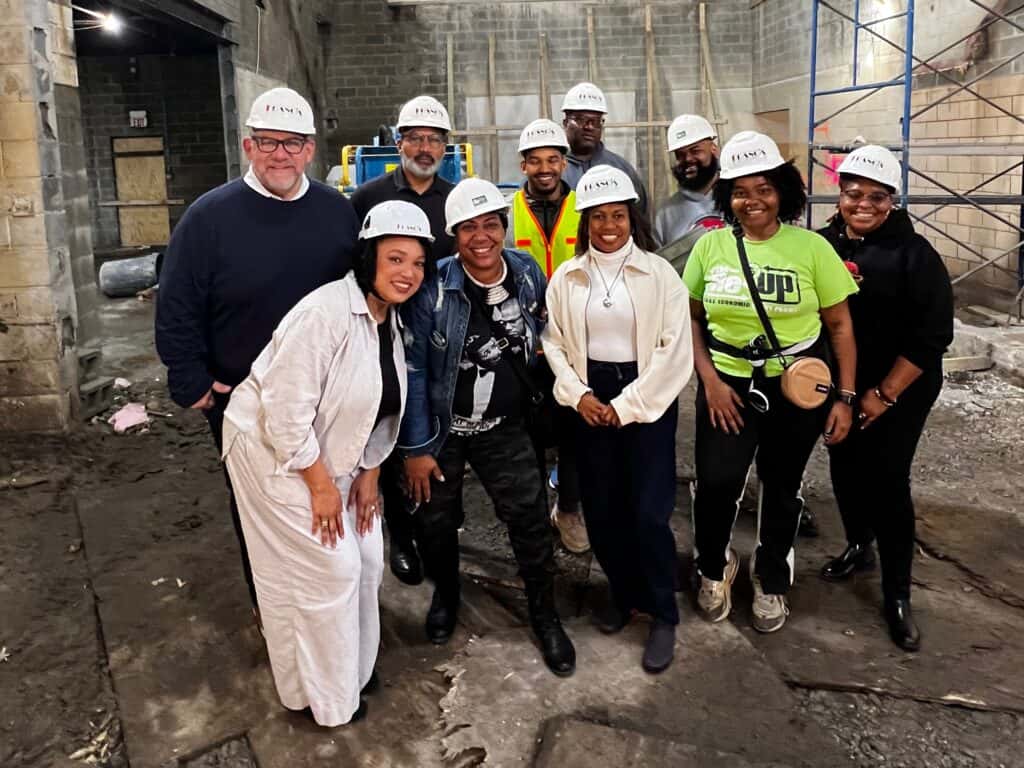
Since its creation in 2010, the Resident Association of Greater Englewood (R.A.G.E.) has been building toward this moment: the groundbreaking for The Re-Up at 59th & Racine—a $6.4 million project that will revitalize the community’s economic and physical landscape. The project represents R.A.G.E.’s clearest public manifestation of its dedicated work to bring resident vision to life.
This celebration carried weight for the Field Foundation, as we had recently selected R.A.G.E. to be our partner in a four-year pilot of our new Community Investments portfolio, reflecting our deepened commitment to resident-led organizations serving Chicago’s South and West Sides. We are making an inaugural $1 million grant, the largest in our history, to help advance R.A.G.E.’s mission of restoring Englewood by mobilizing residents and creating community-led solutions.
Going Above and Beyond the Value of a Grant
For us, this is more than a grant. It is an investment in Englewood. It is an evolution of our social justice work and marks a shift in how we engage in philanthropic practice. Through our Community Investments portfolio, we are taking a more intentional, strategic, and sustained approach to investing in what makes communities thrive.
R.A.G.E. exemplifies the organizations this portfolio intends to support. They have cultivated a membership of community residents. They have invested in their leaders. They have implemented community-led agendas for neighborhood transformation.
A Track Record of Resident-Led Change
Over the past 15 years, R.A.G.E. has proven that when residents lead, communities do thrive. Its track record of turning what residents care about into tangible change includes projects like:
- Buy the Block. R.A.G.E established this online program to convert long-term residents into first-time homeowners. The program is supporting its 16th cohort of residents and currently has 600 potential buyers.
- The Re-Up at 59th & Racine. R.A.G.E. bought a long-vacant building, formerly Leon’s BBQ, from the Chicago Land Bank for $35,000. It secured a $2.5 million grant from the city’s Neighborhood Opportunity Fund to help redevelop the site to host retail spaces, local restaurants and a community gathering place. R.A.G.E. will also move its headquarters to “The Re-Up.”
- The Regenerator. R.A.G.E. is collaborating with Teamwork Englewood, Inner City Muslim Action Network (IMAN), and E.G. Woode on a $33 million project to transform the vacant Woods Elementary School into environmentally sustainable and affordable housing with a job training facility for formerly incarcerated people.
From organizing neighbors block by block to executing multiple, multi-million-dollar neighborhood investments, R.A.G.E.’s footprint in Englewood and its commitment to community-led development is clear.
We Are Our Own Solution
At The Re-Up’s groundbreaking, R.A.G.E.’s co-founder and CEO Asiaha Butler reflected on the origins of the association. “When we started R.A.G.E. in 2010, we really just said, you know what? We live in the community. We are our own solution. We can start on our blocks and stabilize our blocks. And everybody starts saying, yeah, I can do that. I can talk to my neighbors. I can purchase vacant property. I can make a pocket park on my block.”
The lived experience of Asiaha’s reflections, specifically the clarity, determination, and ingenuity to build a neighborhood reflecting resident vision, despite decades of disinvestment, is one of the many things I love about Chicago. I am honored to lead our Community Investments portfolio and look forward to working in partnership with Asiaha and her team to drive lasting change for the residents of Englewood.
Democracy at Work
At the Field Foundation, we see democracy at work when residents organize to take the reins of their communities. This work is a critical balm toward creating the Chicago we all deserve and serves not just this moment, but a lifetime and beyond.
Repairing the effects of disinvestment in Englewood and other South and West Side communities will require comprehensive, cross-sector solutions that center the needs and agendas of residents. R.A.G.E., in its structure, programming, and organizing, is a promising model that we can learn from as we invest in Englewood over the next four years.
As we continue to evolve the Field Foundation’s grantmaking, we aim to be in deeper relationships with the organizations we support, not merely as a funder but as a strategic partner. Through our Community Investments portfolio, we will bring everything we have to the table: dollars, knowledge, relationships, and political capital to support the successful execution of resident-led community agendas.
Investing to Create What Communities Deserve
We see beauty and brilliance on the South and West Sides. Its residents deserve abundance through long-term investment from all sectors, not just splashes or waves of funding. Through our Community Investments work, which we plan to expand to other communities in the future, we intend to provide deep and steady support.
For me, the groundbreaking for The Re-Up wasn’t just a snapshot of how organizations can leverage power and build opportunity. It was a window into what is possible when communities are well resourced to support the lives we all deserve.
We all deserve gainful and sustainable employment. We deserve high-quality education and bustling economic corridors. We deserve spaces to gather and be in community. We deserve access to art, affordable housing, trustworthy local news, wealth building, safety, and care.
Resident-led agendas can build the future we deserve. Let’s follow their lead as we shape a tomorrow where the promise of Chicago secures us all.